Custom Veterinary Medicine Boxes: Compliance at the Clinic Level

Written by Laim Will
Denial Journal Editors
Denial Journal Editors
📅 Updated: September 2026
⏱️ 4 min read
Within the high-stress environment of daily veterinary triage, the physical design of pharmaceutical packaging serves as a critical safeguard against medication errors. With a decade of field experience analyzing animal health logistics, I have seen firsthand how inadequate packaging design compromises workflow accuracy. Truly effective custom veterinary packaging must be treated as a clinical tool, one engineered specifically to protect patient outcomes, satisfy rigorous compliance standards, and maintain flawless inventory management.

Clinical Cost of Poor Packaging Design
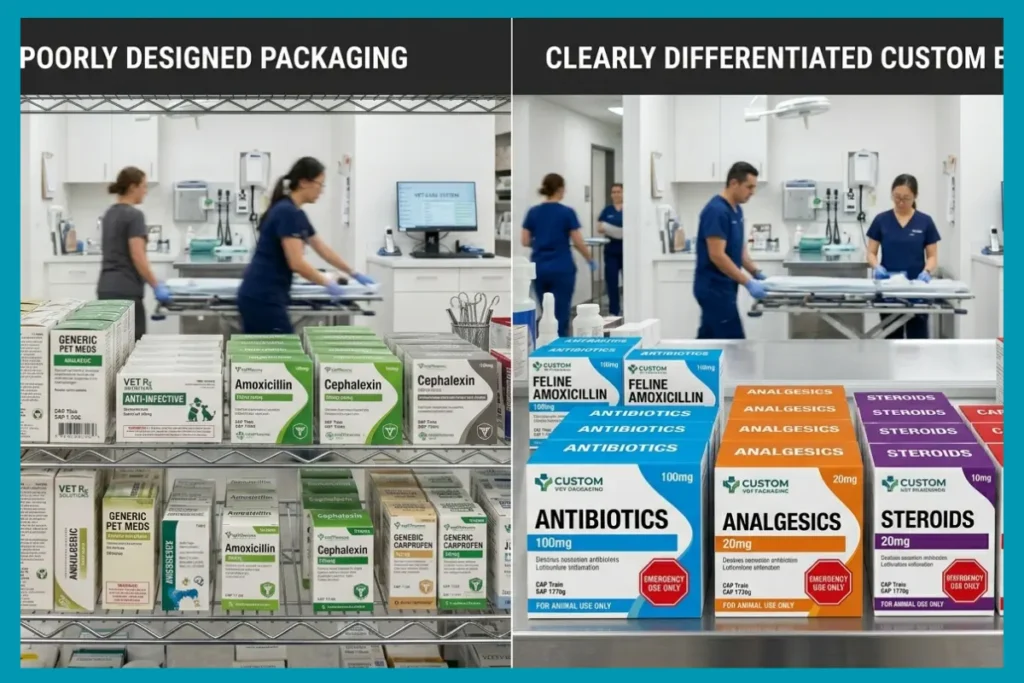
The margin for error in veterinary medicine is virtually nonexistent, as a single mislabeled product can yield fatal consequences. Clinics frequently encounter look-alike packaging from human-use medications, alongside veterinary-specific drug lines utilizing uniform branding that induces visual fatigue. Consequently, standardized carton designs inadvertently force clinical staff to search for critical concentration texts during acute, time-sensitive emergencies.
Custom veterinary medicine boxes solve this by using structural and visual design cues to force physical differentiation at the shelf level. According to a hospital audit published by Silva et al., dedicated veterinary-labeled drugs failed packaging compliance audits up to 30% of the time, often lacking crucial secondary box labeling [1]. Modern clinics increasingly rely on process automation to reduce these operational risks.
Mitigating these clinical risks requires the implementation of custom veterinary medicine boxes that utilize specific design tactics:
- Use bold, contrasting background colors.
- Integrate highly visible, bolded “Tall-Man” lettering.
- Print prominent, oversized concentration indicators.
- Place warning labels on multiple panels.
- Leave dedicated space for clinic labels.
- Use color-coded expiration date blocks [2].
“Uniform packaging and small print sizes on veterinary medications directly contribute to selection errors during high-stress clinical situations.”
Australian Veterinary Association, Veterinary Medication Errors [3]
“The outer carton serves as the primary canvas for essential safety warnings when the vial itself is too small to hold them.”
A. I. Webb & G. Aeschbacher, Journal of the American Veterinary Medical Association [4]
Supply Chain Security and Material Selection
We do not just design for the shelf; we design for the journey. The global animal health supply chain faces rising threats from counterfeit pharmaceuticals, making system security a critical concern for veterinary providers and distributors alike, which Mekonnen et al. warn can contain zero active ingredients [5]. Custom veterinary medicine boxes must integrate security features to safeguard product integrity.
Clinics are also actively demanding sustainable materials to reduce waste [6]. The table below compares the physical and operational performance of standard packaging materials with modern, secure custom alternatives.
Packaging Material and Security Performance Comparison
| Feature / Metric | Standard Chipboard Folding Carton | Engineered Custom Veterinary Medicine Boxes |
| Material Base | Standard bleached virgin wood pulp | Unbleached, biodegradable bio-based kraft board |
| Security Features | None (standard glued flaps) | Fiber-destructive tear-strips & OVD holograms |
| Tamper Evidence | Low; easily resealed with basic adhesive | High; visible fiber tearing upon opening |
| Moisture Resistance | Poor; prone to weakening in clinic refrigeration | High; water-resistant eco-coatings |
| Labeling Real Estate | Minimal; relies on paper inserts | Maximum; prints regulatory text on internal flaps [4] |
| Anti-Counterfeiting | Easy to replicate by counterfeiters | Multi-layered with covert security inks [7] |
“Integrating overt and covert security features into secondary carton packaging is crucial to preventing pharmaceutical counterfeiting.”
— N. Zadbuke, Journal of Pharmacy and Bioallied Sciences [7]
Why Clinics Demand Eco-Friendly Custom Boxes
Let’s talk about the garbage problem. Veterinary clinics generate massive amounts of waste, and veterinary professionals are pushing hard for greener supply chains. Bayrau et al. noted that veterinary and research laboratories must prioritize green packaging to lower their carbon footprint [6]. When you design custom veterinary medicine boxes using biodegradable, unbleached fibers, you help clinics meet their environmental goals while keeping the medications safe.
- Use unbleached, FSC-certified paperboard.
- Avoid plastic-laminated gloss coatings.
- Use soy-based, non-toxic printing inks.
- Optimize box dimensions to reduce waste.
- Choose fully recyclable, flat-folding designs.
- Minimize internal plastic tray inserts.
“Veterinary facilities must transition to bio-based packaging to significantly reduce their massive municipal waste outputs.”
B. A. Bayrau, Open Forum Infectious Diseases [6]
“Properly managed, color-coded inventory packaging reduces drug expiration wastage below the critical two percent threshold.”
Y. T. Mekasha, Frontiers in Veterinary Science [2]
Investing in high-quality custom veterinary medicine boxes is not an aesthetic luxury. It is a practical necessity that protects patients, secures the supply chain, and reduces clinical waste.
Healthcare organizations that ignore operational design risks often experience downstream workflow inefficiencies, preventable waste, and compliance vulnerabilities. Explore more operational optimization insights at Denial Journal
References
- [1] Journal of Hospital Pharmacy and Health Services (Silva Study)
- [2] Frontiers in Veterinary Science (Mekasha Inventory Study)
- [3] Australian Veterinary Association (Medication Errors Report)
- [4] AVMA Journals (Webb & Aeschbacher Container Guide)
- [5] Taylor & Francis (Mekonnen Counterfeit Study)
- [6] Oxford Academic (Bayrau Greening Science Study)
- [7] PMC (Zadbuke Packaging Technology Review)

Laim Will
Lead Revenue Cycle & Compliance AnalystSpecializing in medical billing workflows, claim denial resolutions, and CMS coding compliance.