


Patient registration is the very first step in the medical billing process. Accurate patient registration ensures clean claims and fewer delays in payment posting. In this stage, the healthcare provider collects essential patient and insurance details.
What Is Patient Registration in Medical Billing?
During registration, the administrative staff collects:
- Patient demographic details (their name, date of birth, and address)
- Contact information
- Insurance information
- Emergency contacts
A patient file containing the above-mentioned details is created in the system, serving as the foundation for the entire claim. Any incorrect information here may lead to claim denials later.

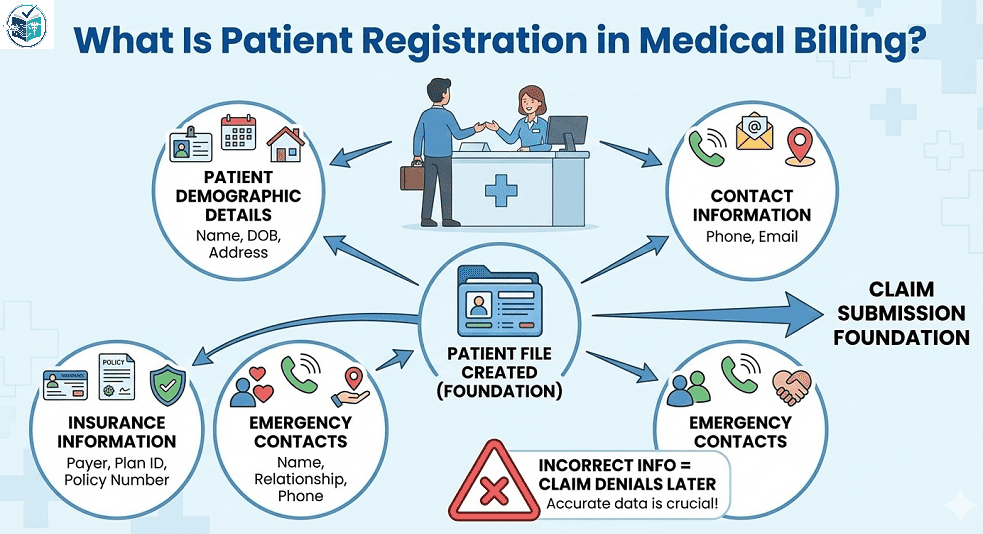
Information Collected During Patient Registration
Below is a detailed insight into what information is collected during patient registration:
Patient Demographics
The front desk collects patients’ necessary information, such as their name, date of birth, and emergency contacts. These details prove beneficial for recognizing a patient in the system. Accurate demographics help in reducing errors.
Insurance Information
The registration team collects insurance data such as policy numbers, plan type, and coverage dates. This information supports the verification of the patient’s insurance. When insurance information is accurate, providers can confirm active coverage even before the services are billed.
Required Forms & Consents
Patients typically fill out forms such as financial responsibility agreements and Assignment of Benefits (AOB). These documents protect the patient’s rights. Proper documentation helps avoid disputes, payment delays, and compliance issues.
Importance of Patient Registration in the Billing Process
Accurate patient registration is a core responsibility in many medical billing career roles; insurance details and correct demographics are fundamental in reducing claim denials and billing errors. Clean registration data ensures that claims are submitted correctly the first time, which ultimately speeds up the reimbursement and strengthens cash flow for the provider (Vozo Health, 2025).
Common Challenges in Patient Registration
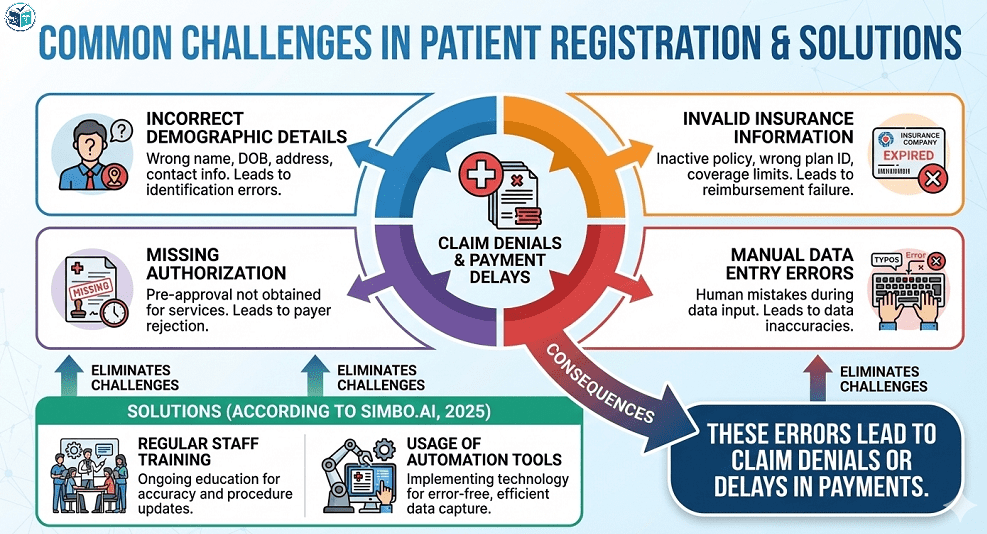
Many medical billing companies in Texas use automated systems to reduce registration errors. Common challenges faced in patient registration are incorrect or incomplete demographic details, invalid insurance information, missing authorization, or human error from manual data entry. These errors can lead to claim denials or delays in payments. According to simbo.ai (2026), these challenges can be eliminated by regular staff training or by the use of automation tools.

Conclusion
Patient registration is the foundation of the medical billing cycle explained; without this, the billing cycle would crumble. When the patient registration is accurate, the entire process becomes more reliable and fast-paced and also less prone to errors. Thus, improving operational efficiency.
Note: The information on denialjournal.com is provided for educational purposes only and is in no way intended to diagnose, cure, or treat any medical or other condition.
References
- Centers for Medicare & Medicaid Services. (2024).
Medicare claims processing manual: Patient registration and billing requirements.
https://www.cms.gov - AHIMA. (2024).
Patient identification and data integrity best practices.
https://www.ahima.org - Agency for Healthcare Research and Quality. (2023).
Patient registration accuracy and its impact on healthcare quality.
https://www.ahrq.gov - Centers for Disease Control and Prevention. (2024).
Standards for demographic data collection in healthcare.
https://www.cdc.gov


About the Author
Laim Will is a medical billing and coding content writer with 5 years of practical experience in Revenue Cycle Management (RCM). She specializes in beginner-friendly medical billing guides, denial management explanations, coding basics, and AR workflow insights.