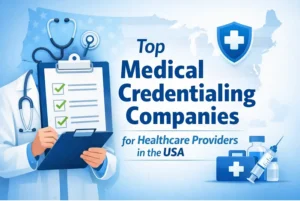
Research By 2026, scientific certification will play an important role in ensuring seamless reimbursement and regulatory compliance for healthcare professionals across the United States. Login errors or delays can prevent your carriers from joining the payer community, resulting in claim denials and significant lost sales. As payer requirements become more complex, many physician practices, clinics and regulatory bodies rely on specialist scientific credentialing companies to register, re-register and manage CAQH profiles. Relying on credentialing staff speeds payer approval, maintains compliance and reduces administrative workload. This article evaluates the top scientific certification agencies in the United States and helps healthcare professionals choose trusted partners for seamless enrollment and long-term sustainable education.
| Medical Credentialing Company (USA) | Best Known For | Key Advantages | Limitations | Pricing Model | Headquarters | Expert Rating |
|---|---|---|---|---|---|---|
| Sirius Solutions Global | End-to-end provider credentialing | Fast approvals, accuracy | Premium pricing | Per provider / custom | United States | 5/5 |
| BellMedEx | Payer enrollment & compliance | Low error rate | Limited automation | Per enrollment | United States | 4.9/5 |
| MedCare MSO | Credentialing + RCM support | Integrated services | Smaller brand reach | Per provider | United States | 4.8/5 |
| CureMD | Automated credentialing workflows | CAQH management | Less customization | Subscription | New York | 4.6/5 |
| Athenahealth | Payer network enrollment | Large payer access | Complex contracts | Bundled pricing | Massachusetts | 4.4/5 |
| Provider Credentialing Solutions | Multi-state licensing | Regulatory expertise | Slower turnaround | Per application | United States | 4.3/5 |
| Verisys | Primary source verification | High compliance | Enterprise-focused | Custom pricing | Minnesota | 4.5/5 |
| CredSimple | Automated credentialing software | Fast processing | Software-only model | Subscription | California | 4.2/5 |
| Modio Health | Centralized provider data | Real-time tracking | Learning curve | Subscription | California | 4.3/5 |
| Dastify Solutions | Affordable credentialing services | Cost-effective | Basic reporting | Per provider | United States | 4.8/5 |
Conclusion
Choosing the right scientific credentialing organization is important to ensure seamless participation in defensive issuer sales and payer networks. Healthcare professionals should evaluate credentialing partners primarily based on payer experience, processing times, tracking transparency, and compliance accuracy. Companies that offer proactive follow-up, CAQH renewals, and login reminders tend to offer higher long-term fees than basic enrollment offerings. Pricing should be weighed against efficiency, as delays in identification often create the potential for incorrect reimbursement.
As healthcare consolidation and payer audits evolve, credentialing services will continue to adapt to automation, centralized data control, and real-time reputation reporting. Providers aligned with trusted, ERA-enabled credential groups will reduce administrative burden, speed up approval of payers, and maintain a consistent flow of coins. Ultimately, effective credentialing practices provide scalability, operational performance, and seamless individual access rights. A partner with a strong reputation for sustainable healthcare in the US is not an option but a strategic asset.

Why is CAQH profile management important?
It provides rapid approval through payers and reduces claim denials due to incomplete or missing facts.
How do credentialing delays affect healthcare practices?
Delays can lead to denied claims, payment interruptions, and revenue loss.
What factors should be considered when choosing a credentialing partner?
Payer satisfaction, processing time, compliance accuracy and monitoring transparency.
How does proper credentialing support long-term practice growth?
This reduces the executive burden and guarantees stable reimbursement and operational stability.
How to get credentialed with medicaid?
To become Medicaid certified, an issuer must submit an enrollment application through the state's Medicaid agency, complete the required documentation, and bypass the verification and approval evaluation.

About the Author
Laim Will is a medical billing and coding content writer with 5 years of practical experience in Revenue Cycle Management (RCM). She specializes in beginner-friendly medical billing guides, denial management explanations, coding basics, and AR workflow insights.