Decoding the Language of RCM
In the world of revenue cycle management workflow, even a single misunderstood acronym may lead to denied claims, delayed payments, or even compliance violations. Medical billing terminology for beginners is about using specific operational language. The language that is understood by payers, clearinghouses, and billing software to avoid confusion among these three entities. Medical billing is not only about submitting claims.
As we move towards 2026, like many other sectors driven by automation, the medical billing landscape is also shifting towards automation. Claim scrubbing, eligibility checks, and claim verification, which were once handled by humans, are now handled by intelligent systems.
These intelligent systems do require the accurate acronyms and billing terms (metadata) that define which services were provided, who provided them, who is going to pay for the services provided, and what the rules are that will be followed in order to clear the reimbursement in top form.
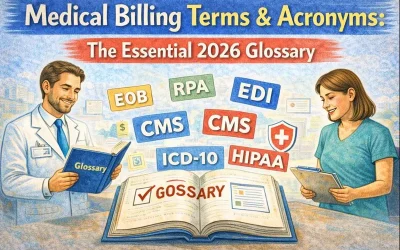
In order to use modern medical billing platforms in an efficient and safe way, billers and practice owners must master these acronyms. In this glossary, we will focus on the most common misunderstood and searched terms, including provider identification, payment reconciliation, compliance notices, and Medicare policy rules.
Provider & Practice Identification (NPI & TIN)
NPI (National Provider Identifier)
National Provider Identifier (NPI) is a unique 10-digit accurate provider identification number assigned to covered healthcare providers across the U.S.
There are two types of identifier numbers for 2026:
- Type 1 NPI: It is issued to individual providers, such as physicians and therapists.
- Type 2 NPI: It is issued to hospitals, clinics, and group practice organizations.
Without a valid NPI, claims cannot be submitted electronically.
TIN (Tax Identification Number)
A Tax Identification Number is a 9-digit number that is used by the Internal Revenue Service
(IRS) to identify a business entity. In the context of medical billing, this number acts as an Employer Identification Number (EIN).
Key difference:
- NPI identifies who provided the care
- TIN identifies who gets paid
Payment & Reconciliation (EOB, ERA, EFT)
EOB (Explanation of Benefits)
An EOB statement is sent by the insurance provider to the patient; this statement covers what services of the bill were covered by the insurance, which services or care were denied by the insurance company, and now what does the patient owe to the healthcare providers?
ERA (Electronic Remittance Advice)
An ERA is the digital version of the EOB; it is sent directly to the providers using the HIPAA 835 transaction format. ERA enables auto-posting; to put it simply, it allows billing software to apply payments and adjustments automatically. Hence, saving the in-house staff from hours of hectic manual work. It also reduces the chances of posting errors.
EFT (Electronic Funds Transfer)
It is the electronic deposit of insurance money directly into the practice’s bank account. Typically, ERA and EFT are paired together to speed up the claim payment process and to improve the cash flow.
Coverage & Compliance (RFA, COB, ABN)
RFA (Request for Authorization)
A Request for Authorization is a formal request sent to the provider to get their approval for a service before the service is performed. If a practice fails to get authorization before performing a service, it can cause claim denial.
COB (Coordination of Benefits)
If a patient has multiple insurance policies, Coordination of Benefits is responsible for determining which insurance policy is primary and which acts as the secondary insurance policy.
To determine the primary insurance policy for dependents, the Birthday Rule is commonly used—the parent whose birthday date falls first in a year is responsible for providing primary coverage.
ABN (Advance Beneficiary Notice)
An Advance Beneficiary Notice is provided to the patients containing the details of the services that are unlikely to be covered by Medicare. Once this notice is signed, it transfers the financial burden to the patient. An ABN is issued before the service is provided, and it should clearly mention the service with its estimated cost.
Medicare Policy & Jurisdictions (LCD & NCD)
NCD (National Coverage Determination)
National Coverage Determination is a nationwide policy issued by CMS. It clearly defines if any item or service will be provided by Medicare or not.
LCD (Local Coverage Determination)
An LCD is a coverage rule created by the Medicare Administrative Contractor (MAC), and this rule is area-specific; it may be applied in one area and not applicable in the other.
If both of these coverages coexist in an area, NCD always overrides the LCD.
Summary Table: Acronym Fast-Track
| Acronym | Stands For | Who receives it? |
| ERA | Electronic Remittance Advice | Provider |
| EOB | Explanation of Benefits | Patient |
| ABI | Advance Beneficiary Notice | Patient (Original Medicare) |
| NPI | National Provider Identifier | Payer/Clearinghouse |
| TIN | Tax Identification Number | IRS/Payer |
| EFT | Electronic Funds Transfer | Provider |
| COB | Coordination of Benefits | Payer |
| RFA | Request for Authorization | Payer |
| NCD | National Coverage Determination | Provider (Nationwide) |
| LCD | Local Coverage Determination | Provider (Regional) |
Conclusion & Next Steps
When practice teams have a crystal-clear understanding of what terms like ERA, EOB, LCD, and NCD are, the claim submission rates are faster, and the denial rates decline significantly. Teams do not need to memorize these terms; what they need to do is have a clear understanding of these terms and their usage.
As a next step, you need to analyze whether your current billing software supports automated ERA posting and links Medicare coverage checks to LCD and NCD rules. Repeated denials and delayed reimbursements are often caused by automation gaps.
Resources
Centers for Medicare & Medicaid Services. Advance beneficiary notice of non-coverage (ABN) tutorial (MLN909183). CMS Medicare Learning Network. Accessed January 9, 2026. https://www.cms.gov/Outreach-and-Education/Medicare-Learning-Network-MLN/MLNProducts/ABN-Tutorial/formCMSR131tutorial111915f.html
US Department of Health and Human Services. Accessed January 9, 2026. https://www.hhs.gov
American Medical Association. CPT® overview and code approval. Accessed January 9, 2026. https://www.ama-assn.org/practice-management/cpt/cpt-overview-and-code-approval

About the Author
Laim Will is a medical billing and coding content writer with 5 years of practical experience in Revenue Cycle Management (RCM). She specializes in beginner-friendly medical billing guides, denial management explanations, coding basics, and AR workflow insights.